FSBSI ARRIAM
Federal State Budget Scientific Institution
All-Russia Research Institute for Agricultural Microbiology
All-Russia Research Institute for Agricultural Microbiology





- Visually impaired version
18.06.2026
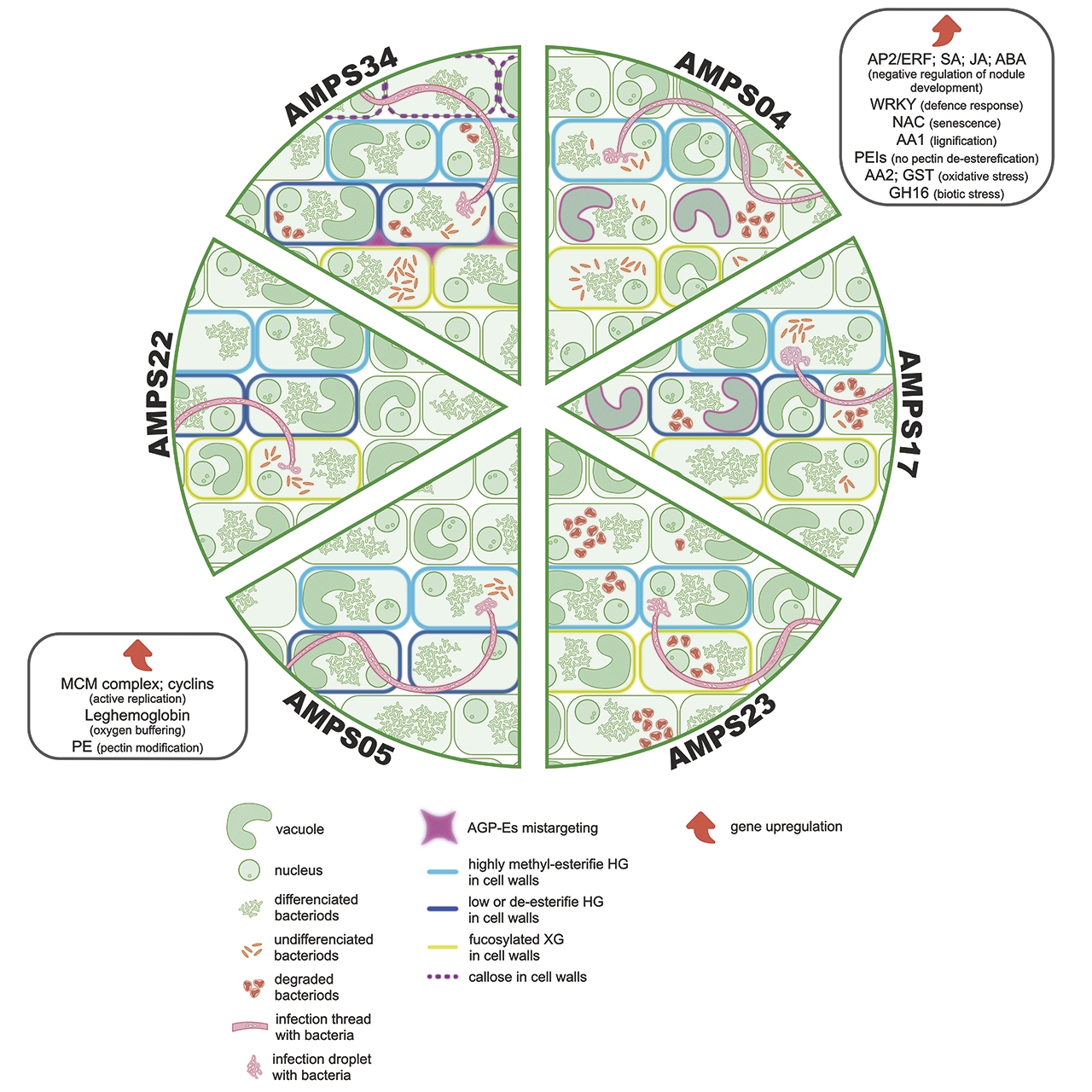
The team of the Laboratory of Molecular and Cellular Biology, led by PhD A.V. Tsyganova, published an article in the Proto-Elam journal on the study of the symbiotic interface in nitrogen-fixing nodules of peas (pisum sativum L.) induced by various strains of nodule bacteria laguerreae. It was shown that some strains induced the formation of effective nodules, while others induced ineffective nodules with excellent organization of the symbiotic interface. Ineffective nodules were characterized by the absence of accumulation of deesterified homogalacturonane. In addition, when inoculating pea plants with certain strains of R. laguerreae, abnormal localization of arabinogalactane proteins, arabinogalactane protein-extensin, and callose was observed, indicating the involvement of these components in protective mechanisms during symbiosis. Transcriptomic analysis of ineffective nodules revealed activation of plant defense reactions and responses to biotic stresses.
Thus, for the first time, the symbiotic interface was characterized using a single plant genotype and several rhizobium strains differing in symbiotic efficacy. On the one hand, it was found that the inefficiency of nodules leads to changes in the symbiotic interface. On the other hand, it has been shown that the spectrum of these changes can vary significantly in nodules induced by different strains of rhizobia. These results clearly indicate the need for strict selection of symbiotic pairs for use in agricultural production.
The study was carried out within the framework of the Russian Science Foundation project 23-16-00090.
Kirichek E.A., Kusakin P.G., Gorshkov A.P., Tsyganova A.V., Tsyganov V.E. Symbiotic interface in the interaction of Pisum sativum L. and Rhizobium laguerreae. Protoplasm (2026). https://doi.org/10.1007/s00709-026-02229-3
