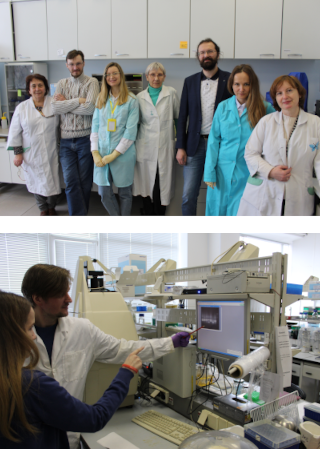
Laboratory of Genetics of plant-microbial interactions №9

Laboratory of Genetics of plant-microbial interactions №9

Head of the laboratory : Zhukov Vladimir Alexandrovich

Phone: +7 (812) 470 51 83

The team of the Laboratory of Genetics of Plant-Microbe interactions under the leadership of Dr. Vladimir Alexandrovich Zhukov performs research on deciphering the molecular genetic mechanisms of mutually beneficial symbioses formed by legumes with nodule bacteria, arbuscular mycorrhizal fungi and beneficial rhizospheric/endophytic bacteria. Bioinformatics methods are used in research to analyze "big data" obtained using "omic" approaches - NGS sequencing of transcriptomes and genomes, metabolomics and proteomics.

The instrument park, which includes powerful servers for computing and data storage, allows solving scientific problems at the modern level and claiming a world priority, and carrying out all molecular biological procedures: synthesis of libraries for NGS sequencing (Illumina and Oxford Nanopore Technology), PCR (including the real time PCR), sample preparation for metabolomic and transcriptomic analysis, etc .

Currently, the laboratory staff performs research within the framework of two grants from the Russian Science Foundation (including the joint project with N.I.Vavilov All-Russian Institute of Plant Genetic Resources (VIR)).

The laboratory was previously headed by Doctor of Biological Sciences, Professor, Academician of the Russian Academy of Sciences I.A. Tikhonovich (in the period 1984 – 2001) and Doctor of Biological Sciences A.Y. Borisov (in the period 2001 – 2014). Since September 2014, the laboratory has been headed by Candidate of Biological Sciences Vladimir Alexandrovich Zhukov.

The laboratory cooperates with St. Petersburg State University (Departments of Genetics and Biotechnology, Biochemistry, Physiology and Biochemistry of Plants), V.L. Komarov Botanical Institute, Sirius University of Science and Technology, N.I. Vavilov All-Russian Institute of Plant Genetic Resources (VIR).

We invite students and postgraduates to cooperate in the preparation of qualification works (bachelor's/ master's degrees, PhD thesis). Possible topics of work can be found here. Information about admission to the graduate school of the ARRIAM – here and here.


Main areas of scientific work

Staff

PROPOSED TOPICS FOR QUALIFICATION WORKS


GRANTS 


CURRENTLY BEING PERFORMED


Russian Science Foundation

  • RSF (25-74-10122) The role of non-coding RNA and genes encoding short peptides in the development of pea plants (Pisum sativum L.) and their responses to abiotic stress. 2025-2028. Head: Zorin E.A.
  • RSF (23-16-00195) Identification of physiological and molecular markers to search for drought-resistant and highly productive genotypes in the gene pool of guar (Cyamopsis tetragonoloba (L.) Taub.) - initial material for breeding domestic varieties. 2023-2025. Head: Vishnyakova M.A.


COMPLETED


Russian Science Foundation

  • RSF (22-16-00109) Molecular genetic bases of symbiotic responsivity of garden pea (Pisum sativum L.). 2022-2024. Head: Zhukov V.A.
  • RSF (20-16-00107) Metabolomic and transcriptomic changes in seeds and leaves of garden pea (Pisum sativum L.) during the formation of complex plant-microbe systems. 2020-2022. Head: Shtark O.Y.
  • RSF (17-76-30016) Scientific bases for the creation of an effective technology for the stabilization of plant growth and development in a multicomponent plant-microbial system. 2017-2020. Head: Tikhonovich I.A.
  • RSF (16-16-00118-P) Transcriptome variability in forms of legume plants with different efficiency of nitrogen and phosphorus nutrition. 2019-2020. Head: Zhukov V.A.


Russian Foundation of Basic Research

  • RFBR (20-04-01136) New mechanisms of systemic regulation of arbuscular mycorrhiza development in pea. 2020-2022. Head: Shtark O.Y.
  • RFBR (19-316-90058 – PhD Students) Regulation of arbuscular-mycorrhizal symbiosis development by alternative splicing and microRNA in pea (Pisum sativum L.). 2019-2022. Head: Zhukov V.A.
  • RFBR (19-316-51014 – Scientific mentoring) “Symbiogenomics”: genetic and metabolic integration in the supraorganismal symbiotic system “pea – nodule bacteria”. 2019-2021. Head: Zhukov V.A.
  • RFBR (19-016-00194) Bacterial endophytic community of the aerial part of the pea (Pisum sativum L.): patterns of formation and growth-stimulating activity. 2019-2021. Head: ZhukovV.A.


Saint Petersburg State University

  • Event 1. Study of the mechanisms of nitrate-mediated regulation of the development of symbiotic nodules in garden pea (Pisum sativum L.) and barrel medic (Medicago truncatula Gaertn.) using genomic technologies. 2020-2022. Head: Zhukov V.A.


Government of the Russian Federation

  • World-Class Scientific Center "Agrotechnologies of the Future" (as part of the consortium) 2020-2024. Research topic of the laboratory: Comparative genomics of economically significant species of leguminous plants, aimed at identifying key determinants that determine the effectiveness of plant-microbial interactions

Publications

  1. Zhernakov A.I., Gordon M.L., Zorin E.A., Sulima A.S., Zhukov V.A. (2025) Application of Quantitative Trait Loci (QTL) mapping to study the interactions of pea (Pisum sativum L.) with rhizosphere microorganisms. Ecological genetics, 23(1), 65-79. https://doi.org/10.17816/ecogen642710.
  2. Sulima A.S., Rakova V.A., Zhukov V.A. (2025) Symbiotic responsivity of pea (Pisum sativum L.): history of study and the state of the art (a review).Agricultural Biology, 60(3), 415-431. https://doi.org/10.15389/agrobiology.2025.3.415rus.
  3. Kuzmina D.O., Zorin E.A., Sulima A.S., Romanyuk D.A., Gordon M.L., Zhernakov A.I., Kulaeva O.A., Akhtemova G.A., Shtark O.Y., Tikhonovich I.A., Zhukov V.A. (2025) Transcriptomic analysis of the symbiotic responsivity trait in pea (Pisumsativum L.). Vavilov Journal of Genetics and Breeding, 29(2), 248-258. https://doi.org/10.18699/vjgb-25-28.
  4. Frolov A., Shumilina Ju., Etemadi Afshar S., Mashkina V., Rhomanovskaya E., Lukasheva E., Tsarev A., Sulima A.S., Shtark O.Y., Ihling Ch., Soboleva A., Tikhonovich I.A., Zhukov V.A. (2025) Responsivity of two pea genotypes to the symbiosis with rhizobia and arbuscular mycorrhiza fungi — a proteomics aspect of the “efficiency of interactions with beneficial soil microorganisms” trait. International Journal of Molecular Sciences, 26(2), 463. https://doi.org/10.3390/ijms26020463.
  5. Sulima A.S., Zhuravlev I.Yu., Alexeeva E.A., Kliukova M.S., Zorin E.A., Rakova V.A., Gordon M.L., Kulaeva O.A., Romanyuk D.A., Akhtemova G.A., Zhernakov A.I., Semenova E.V., Vishnyakova M.A., Tikhonovich I.A., Zhukov V.A. (2025) The genomic and phenotypic characterization of the Sym2A introgression line A33.18 of pea (Pisum sativum L.) with the increased specificity of root nodule symbiosis. Plants, 14(3), 427. https://doi.org/10.3390/plants14030427.
  6. Kulaeva O.A., Zorin E.A., Sulima A.S., Akhtemova G.A., Zhukov V.A. (2024) Draft genome sequence of the commercial strain Rhizobium ruizarguesonis bv. viciae RCAM1022. Data, 9(2), 19. https://doi.org/10.3390/data9020019.
  7. Zorin E.A., Sulima A.S., Zhernakov A.I., Kuzmina D.O., Rakova V.A., Kliukova M.S., Romanyuk D.A., Kulaeva O.A., Akhtemova G.A., Shtark O.Y., Tikhonovich I.A., Zhukov V.A. (2024) Genomic and transcriptomic analysis of pea (Pisum sativum L.) breeding line ‘Triumph’ with high symbiotic responsivity. Plants, 13(1), 78. https://doi.org/10.3390/plants13010078.
  8. Shumilina Ju., Soboleva A., Abakumov E., Shtark O.Y., Zhukov V.A., Frolov A. (2023). Signaling in legume–rhizobia symbiosis. International Journal of Molecular Sciences, 24(24), 17397. https://doi.org/10.3390/ijms242417397.
  9. Lebedeva M.A., Gancheva M.S., Kulaeva O.A., Zorin E.A., Dobychkina D.A., Romanyuk D.A., Sulima A.S., Zhukov V.A., Lutova L.A. (2022). Identification and expression analysis of the C-TERMINALLY ENCODED PEPTIDE family in Pisum sativum L. International Journal of Molecular Sciences, 23(23), 14875. https://doi.org/10.3390/ijms232314875.
  10. Lebedeva M.A., Sadikova, D.S., Dobychkina, D.A., Zhukov V.A., Lutova L.A. (2022). CLAVATA3/EMBRYO SURROUNDING REGION genes involved in symbiotic nodulation in Pisum sativum. Agronomy, 12(11), 2840. https://doi.org/10.3390/agronomy12112840.
  11. Zorin E.A., Kliukova M.S., Afonin A.M., Gribchenko E.S., Gordon M.L., Sulima A.S., Zhernakov A.I., Kulaeva O.A., Romanyuk D.A., Kusakin P.G., Tsyganova A.V., Tsyganov V.E., Tikhonovich I.A., Zhukov V.A. (2022). A variable gene family encoding nodule-specific cysteine-rich peptides in pea (Pisum sativum L.). Front Plant Sci., 13: 884726. https://doi.org/10.3389/fpls.2022.884726.
  12. Sulima A.S., Zhukov V.A. (2022). War and peas: molecular bases of resistance to powdery mildew in pea (Pisum sativum L.) and other legumes. Plants, 11(3), 339. https://doi.org/10.3390/plants11030339.
  13. Zhukov V.A.; Zhernakov A.I.; Sulima A.S.; Kulaeva O.A.; Kliukova M.S.; Afonin A.M.; Shtark O.Y.; Tikhonovich I.A. (2021). Association study of symbiotic genes in pea (Pisum sativum L.) cultivars grown in symbiotic conditions. Agronomy, 11(11), 2368. https://doi.org/10.3390/agronomy11112368
  14. Afonin A.M., Gribchenko E.S., Zorin E.A., Sulima A.S., Zhukov V.A. (2021). DNA methylation patterns differ between free-living rhizobium leguminosarum RCAM1026 and bacteroids formed in symbiosis with pea (Pisum sativum L.). Microorganisms, 9(12), 2458. https://doi.org/10.3390/microorganisms9122458.
  15. Zhukov V., Zorin E., Zhernakov A., Afonin A., Akhtemova G., Bovin A., Dolgikh A., Gorshkov A., Gribchenko E., Ivanova K., Kirienko A., Kitaeva A., Kliukova M., Kulaeva O., Kusakin P., Leppyanen I., Pavlova O., Romanyuk D., Rudaya E., Serova T., Shtark O., Sulima A., Tsyganova A., Vasileva E., Dolgikh E., Tsyganov V., Tikhonovich I. (2021). Transcriptomic analysis of sym28 and sym29 supernodulating mutants of pea (Pisum sativum L.) under complex inoculation with beneficial microorganisms. Biological Communications, 66(3): 181–197.   https://doi.org/10.21638/spbu03.2021.301
  16. Solovev Y.V., Igolkina A.A., Kuliaev P.O., Sulima A.S., Zhukov V.A., Porozov Y.B., Pidko E.A., Andronov E.E. (2021). Towards understanding Afghanistan pea symbiotic phenotype through the molecular modeling of the interaction between LykX-Sym10 receptor heterodimer and Nod factors. Frontiers in Plant Science, 12, 642591. https://doi.org/10.3389/fpls.2021.642591.
  17. Shtark O., Puzanskiy R., Avdeeva G., Yemelyanov V., Shavarda A., Romanyuk D., Kliukova M., Kirpichnikova A., Tikhonovich I., Zhukov V., Shishova, M. (2021). Metabolic alterations in Pisum sativum roots during plant growth and arbuscular mycorrhiza development. Plants, 10(6), 1033. https://doi.org/10.3390/plants10061033.
  18. Afonin A.M., Gribchenko E.S., Zorin E.A., Sulima A.S., Romanyuk D.A., Zhernakov A.I., Shtark O.Y., Akhtemova G.A., Zhukov V.A. (2021). Unique transcriptome features of pea (Pisum sativum L.) lines with differing responses to beneficial soil microorganisms. Ecological genetics, 19(2), 131-141. https://doi.org/10.17816/ecogen54703.
  19. Zorin E.A., Afonin A.M., Kulaeva O.A., Gribchenko E.S., Shtark O.Y., Zhukov V.A. (2020). Transcriptome analysis of alternative splicing events induced by arbuscular mycorrhizal fungi (Rhizophagus irregularis) in pea (Pisum sativum L.) roots. Plants, 9(12), 1700. https://doi.org/10.3390/plants9121700.
  20. Afonin A.M., Leppyanen I.V., Kulaeva O.A., Shtark O.Y., Tikhonovich I.A., Dolgikh E.A., Zhukov V.A. (2020). A high coverage reference transcriptome assembly of pea (Pisum sativum L.) mycorrhizal roots. Vavilov Journal of Genetics and Breeding, 24(4), 331–339. https://doi.org/10.18699/VJ20.625.
Что будем искать?