FSBSI ARRIAM
Federal State Budget Scientific Institution
All-Russia Research Institute for Agricultural Microbiology
All-Russia Research Institute for Agricultural Microbiology





- Visually impaired version
20.07.2026
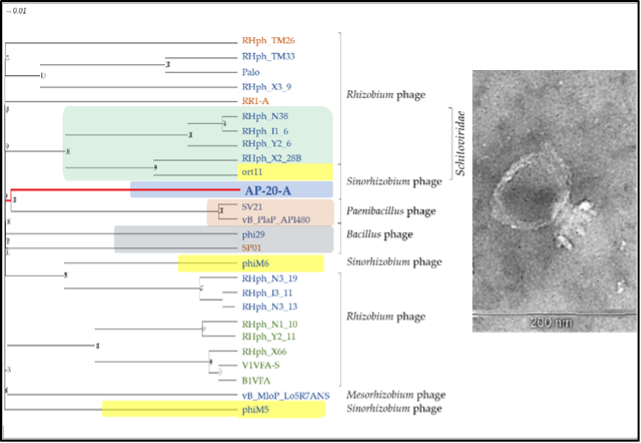
The team of the Laboratory of Microbiology Genetics and Selection under the leadership of M.L. Rumyantseva published in the International Journal of Molecular Sciences (IJMS) an article devoted to the analysis of a new lytic podovirus AP-20-A isolated from soils of an agrocenosis and infecting bacteria Sinorhizobium meliloti – alfalfa symbionts. The phage genome is mosaic and demonstrates kinship with Paenibacillus phages, which indicates interfilum horizontal transfer in the rhizosphere. For the first time, a gene encoding the Tad2 protein, which is involved in the suppression of Thoeris bacterial defense, has been identified in the genome of a rhizobiophage. The phage infects 56% of the tested natural strains and effectively lyses the inoculated strain within a few hours, but some resistant soil isolates carry the AbiE defense system, which may provide them with resistance to this phage. The obtained data demonstrate an example of coevolution of a phage and a bacterial host in the soil environment of agrocenoses and confirm the significance of phages as a factor limiting the effectiveness of the use of biological products.
Kozlova, A.P.; Roumiantseva, M.L.; Saksaganskaia, A.S.; Vladimirova, M.E.; Muntyan, V.S.; Gorbunova, M.K.; Gorshkov, A.N. A Novel Lytic Podovirus AP-20-A Infecting Sinorhizobium meliloti: Mosaic Genome with Cross-Phylum Homology and Implications for Inoculant Establishment. Int. J. Mol. Sci. 2026, 27, 5515. https://doi.org/10.3390/ijms27125515
