FSBSI ARRIAM
Federal State Budget Scientific Institution
All-Russia Research Institute for Agricultural Microbiology
All-Russia Research Institute for Agricultural Microbiology





- Visually impaired version
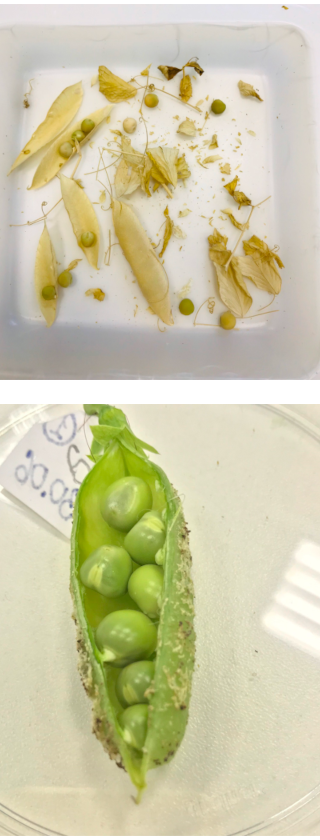
The laboratory is working on identifying the molecular genetic basis of the trait "efficiency of interaction with beneficial soil microorganisms" (EIBSM). This trait is defined as an increase in seed productivity of peas (or other legumes) under the influence of inoculation with nodule bacteria and arbuscular mycorrhiza fungi (Shtark et al., 2012). This trait is also called the “symbiotic responsivity” (Сулима и др., 2025). The work carried out within the framework of the RSF project 16-22-00109 under the supervision of Dr. Zhukov V.A. allowed us to establish that the manifestation of the EIBSM trait is largely associated with the activation of systemic resistance of pea plants under the influence of inoculation (Kuzmina et al., 2025; Frolov et al., 2025).
To conduct genetic analysis of this trait using quantitative trait loci (QTL) mapping, a population of recombinant inbred lines (RIL), currently represented by the F10 generation, was obtained by crossing the "responsive" pea genotype k-8274 and the "non-responsive" genotype k-3358. At the F7 generation stage, plants of this population were grown under control conditions (without inoculation) and with inoculation, and genotyped using an RNA sequencing modification called MACE (massive analysis of cDNA ends). The analysis of phenotyping and genotyping data currently being conducted will allow QTL mapping to identify the quantitative trait loci containing the genes responsible for the manifestation of the EIBSM trait. The results of this work will allow identifying molecular markers that can be used in breeding. Next year, a repeat phenotypic analysis is planned for inoculation under drought stress conditions to assess the beneficial effects of inoculation on plants and to identify QTLs responsible for the expression of drought tolerance stimulated by the resulting symbioses.
Recently, work has begun on the RSF project 25-74-10122 under the supervision of Dr. E.A. Zorin to identify the role of non-coding RNA (including microRNA) and RNA encoding short peptides in the resistance of pea plants to stress of various origins. In the course of this work, the cv. Frisson pea genome sequenced and assembled in our laboratory is being annotated, and non-coding RNA, microRNA and RNA encoding short peptides are being identified, and the expression level of these RNAs is being assessed under control and stress conditions.
Also, within the framework of the RSF project 23-16-00195 under the supervision of DSc Vishnyakova M.A. (Vavilov All-Russian Institute of Plant Genetic Resources (VIR)), the laboratory staff studied the transcriptome, proteome and metabolome of ripening guar seeds. Guar (Cyamopsis tetragonoloba (L.) Taub.) is a new crop for the Russian Federation, which is of significant value due to guar gum, a seed ingredient used in various sectors of the national economy, including the gas and oil industry. The study revealed differences at the molecular level between a drought-resistant guar variety and a drought-sensitive variety, and the results will be used in breeding work.
